

Is Local Action One of the Best Ways to Fight Big Tech?
Hello and welcome to the latest edition of my newsletter, Poiesis. This newsletter is where I share my research and practice relating to society and technology — AI, misinformation, surveillance, ethics, and more. It’s my way to help you understand and change the rapidly changing world of social technology.
In this edition, I’m going to share back some of the whirlwind that I’ve recently been on surrounding local fights against data centers. My last newsletter, almost a month ago, detailed the beginnings of a fight in Monterey Park against a proposed data center. In the month that’s passed (seeming like 6 months), there have been updates and twists and turns that are worth learning from.
I’m hoping to center this on local action. It’s been striking me, as I’ve been on this journey, that usually we imagine national legislation as the best way to fight Big Tech. Obviously, that’s not in the cards right now. What can we learn from this moment when local action, taking place across the nation, is seemingly throwing a bigger wrench in Big Tech’s agenda than any proposed legislation ever did?
Updates from Monterey Park
Since the last newsletter, a lot has happened in the Monterey Park data center fight.
Last I shared back, one of the local groups helping organize against the project, SGV Progressive Action [link], had held a teach-in on the data center. I attended and was shocked by how many residents showed up — nearly 200. I was equally shocked by the fact that the social media posts I made about the teach-in also blew up and reached hundreds of thousands of people.
The response to the teach-in — folks learning about the project and its details — was very revealing of the attitudes of people about these data centers. At the in-person event, people were so grateful to know and ready to fight back. In the comments on my social posts, people were also frequently saying they had no idea about this, and asking what they can do.
After that, the folks organizing against the data center, now newly minted as No Data Center Monterey Park (NDCMPK), created a petition folks could sign to express their call to reject the data center. They planned to deliver it to City Council in late January.
Little did we know, that petition got thousands of signatures. There was massive support against the data center, and we had the numbers. And this energy was reflected at the City Council meeting. The chamber was packed with hundreds of residents, and nearly 100 people gave public comment at the meeting — which lasted nearly four hours — expressing their disappointment in the Council and their clear ask to reject the data center. At the end of the night, well past midnight, several councilmembers surprised us again by declaring that they were in favor of a total ban on data centers in Monterey Park. We were filled with joy as our hard work was paying off.
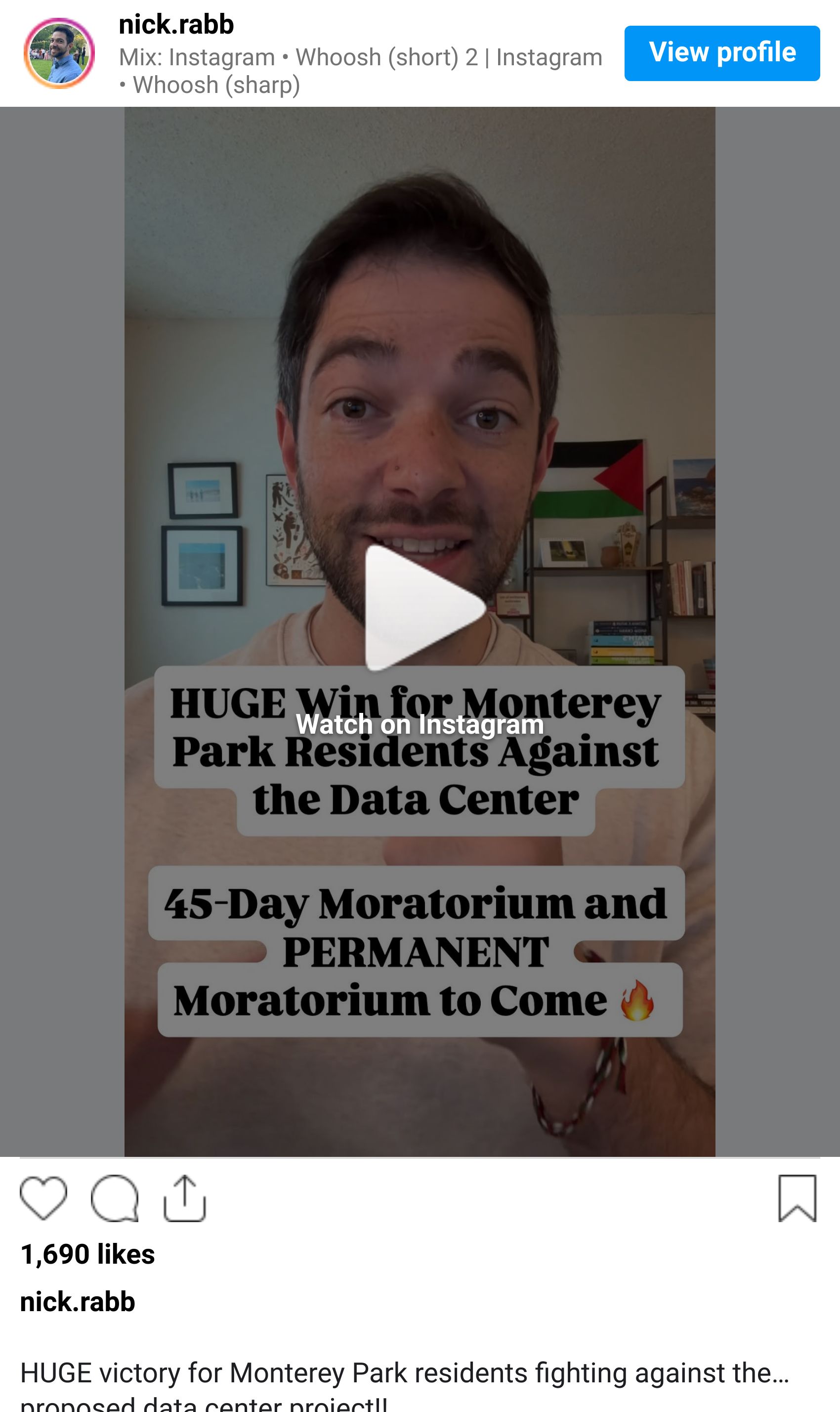
We were eagerly awaiting further progress after that electrifying City Council meeting. Yet what came was not what we expected. The City shifted its view, moving from leaning towards drafting a ban ordinance to favoring a ballot measure that would instate the ban, turning it to residents.
At first, I was pretty angry. This seemed like an abdication of responsibility on the part of the Council, and a clear avenue for HMC Capital (the developer) to use the time until the ballot measure vote for disinformation and trickery. Some informed me that the ballot measure may be a legally more secure way to do this ban, as it’s harder to challenge in court or overturn later. But we’re not entirely sure about that yet.
As it stands, we remain in this limbo state. During the January Council Meeting, the Council issued a temporary 45-day moratorium on data center construction. That moratorium expires on March 4th, when there will be another Council meeting. We plan to pack that meeting and urge the Council to be smart and fight.
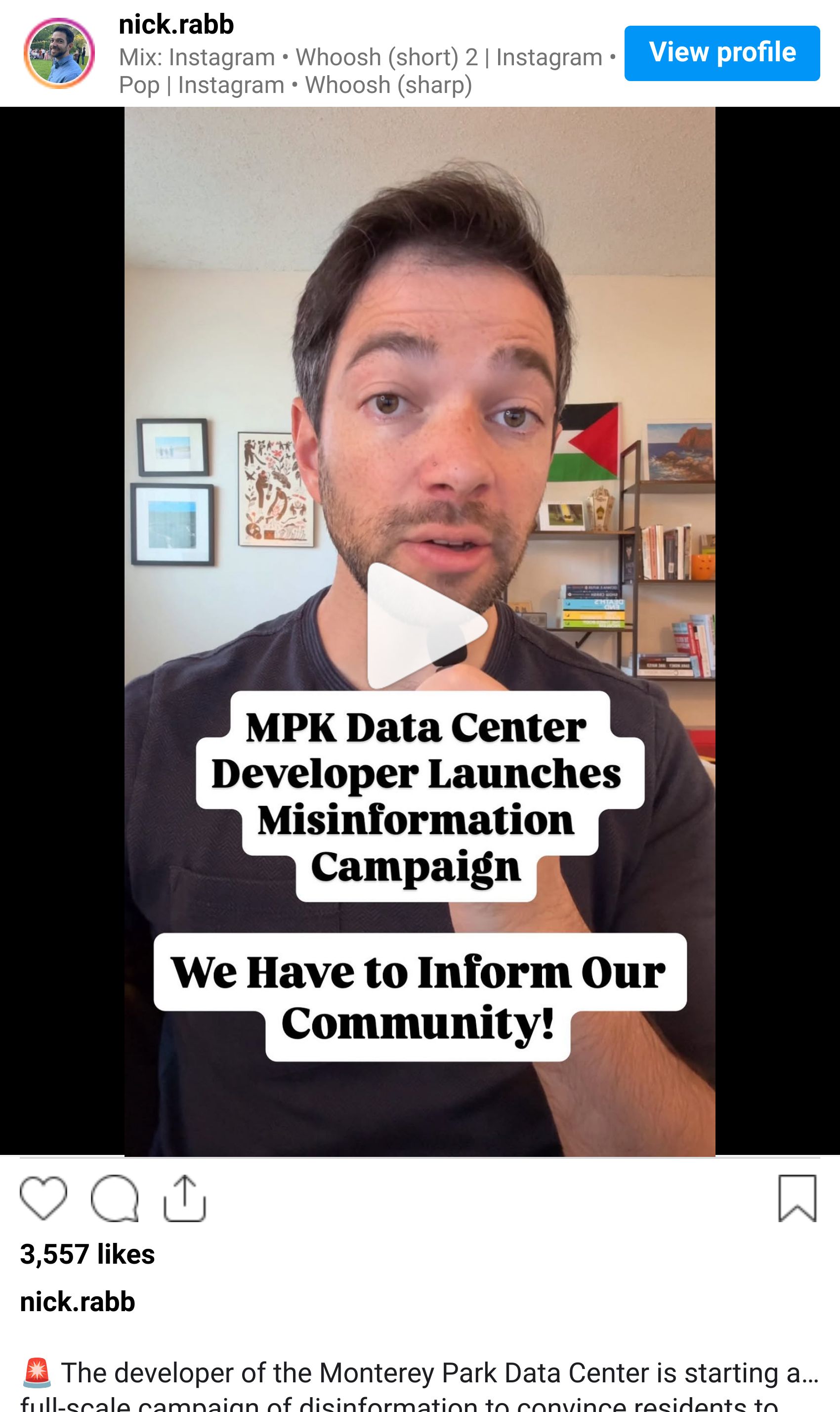
And predictably, HMC Capital has indeed used the intervening month to start a coordinated disinformation campaign. It created an IG account to push ads to residents. They’ve hired PR firms to send representatives to local meetings and businesses to try to sway residents. They’re also canvassing door-to-door with their own materials, and have stood up a whole website dedicated to painting a rosy picture of the project.
Residents and I created a propaganda debunking doc poking holes in each of their lies and calling out their manipulative tactics.
The status now is uncertain. NDCMPK seems to be formulating a strategy if the City Council pushes for a ballot measure or not. Their newsletters (which you should subscribe to) indicate they are trying to keep the Council open to all methods of stopping the data center. We will see what ends up being the case, likely on March 4th.
Local Action Against National Issues
One of the things I’ve been grappling with the most during this intense journey into data center conflict is how I make sense of the tactics.
During my time organizing with Sunrise Movement and more generally in the climate justice space, I became familiar with many environmental justice fights. There were local battles against coal plants in New Hampshire, a substation in Eastie. I learned about the battles in West Roxbury decades ago where residents fought against a fracked gas pipeline by putting their bodies on the line. I even spent time at the Line 3 pipeline site, fighting against it with Indigenous leaders who were really sacrificing a lot to try to preserve clean water and land sovereignty. These were each harrowing battles against polluting infrastructure — some victories, some losses.
What strikes me about the data center fight is how successful it has been. Though it’s now an out-of-date number, Data Center Watch reported last year that from May 2024 to March 2025, $64 billion in data center projects had been blocked or delayed by local action. In fact, it’s been so successful that Chris Wright, the current U.S. Energy Secretary, warned data center developers at the North American Gas Forum in December that they were losing control of the narrative. And the Trump administration has been forced to try to push tech companies to change tactics, encouraging them to pay for the extra energy costs imposed by data centers.
This is an enormous success that I have not been aware of in any other fight against Big Tech or for environmental justice. As a result, I’m sitting down and reflecting on why this movement is so effective.
I think that there are some macro-level reasons that the anti-data center movement is so successful — factors that are true across all data center fights. For one, the backlash is bipartisan. Data Center Watch also pointed this out in their reporting, where they found from their study of 28 states’ data center fights that 55% of politicians taking stances against data centers are Republicans and 45% Democrats. On the left, folks are opposing the environmental impacts. On the right, people have problems with the tax abatements developers are receiving. Reactions to power consumption, rising bills, and energy grid strain are cross-cutting.
Moreover, another macro-level reason the fight is so successful may be that AI is deeply unpopular. Pew Research found in September of last year that 50% of Americans are more concerned than excited about AI, 38% are equally concerned and excited, and only 10% are more excited than concerned. They also found that 61% of polling respondents said they “would like more control over how AI is used in their lives.” Almost everyone I talk to has concerns about AI. It makes sense that the infrastructure that is being built to power it will also be subject to the same scrutiny.
But there are also more micro-level aspects of the fight that may be critical to its success. For example, data centers are easily targetable, physical infrastructure subject to municipal governance. Many successful data center fights have taken aim at the permits required for building, or at zoning laws allowing or disallowing types of infrastructure. There are clear channels of power to work through, and working within one city or municipality is often easier because folks are already embedded in community structures in their locality.
This is a critical type of thinking to adopt as we collectively struggle to fight against Big Tech. So much of their infrastructure ends up being deployed at a local level: Ring doorbells in your neighborhood, local offices for tech companies, data centers, ed tech in schools, and more. Perhaps these arenas are more strategic, manageable targets to go after to throw wrenches in the Big Tech machine.
There is a lot to learn from the data center battle, and I plan on writing more on this subject. So, look out for that.
A Shorter Newsletter This Edition
That about wraps it up. Apologies that this newsletter is shorter than usual. Like I mentioned, it’s been a bit of a whirlwind moment for me personally, so I appreciate your collective patience.
Lots more interesting stuff coming down the line soon. Stay tuned!
This newsletter provides you with critical information about technology, democracy, militarism, climate and more — vetted by someone who’s been trained both as a scholar and community organizer.
Use this information to contribute to your own building of democracy and fighting against technological domination! And share it with those who would be interested.
Until next time 📣