

Critical AI and How to Start Changing Unjust Tech
Hello and welcome to the latest edition of my newsletter, Poiesis. This newsletter is where I share my research and practice relating to society and technology — AI, misinformation, surveillance, ethics, and more. It’s my way to help you understand and change the rapidly changing world of social technology.
In this edition, I want to share back some work I’ve been doing around critical thinking and AI. It’s a space that I am increasingly finding myself bumping up against, as AI tech is spreading fast and without much thought.
I want to share with you some resources I’ve found helpful to counteract illegitimate AI hype, some critical takes on AI implementation, and how we may be able to start pushing back.
Countering AI Hype
First, I want to share some resources that I recently created introducing some books that I’ve found tremendously helpful in cutting through AI hype.
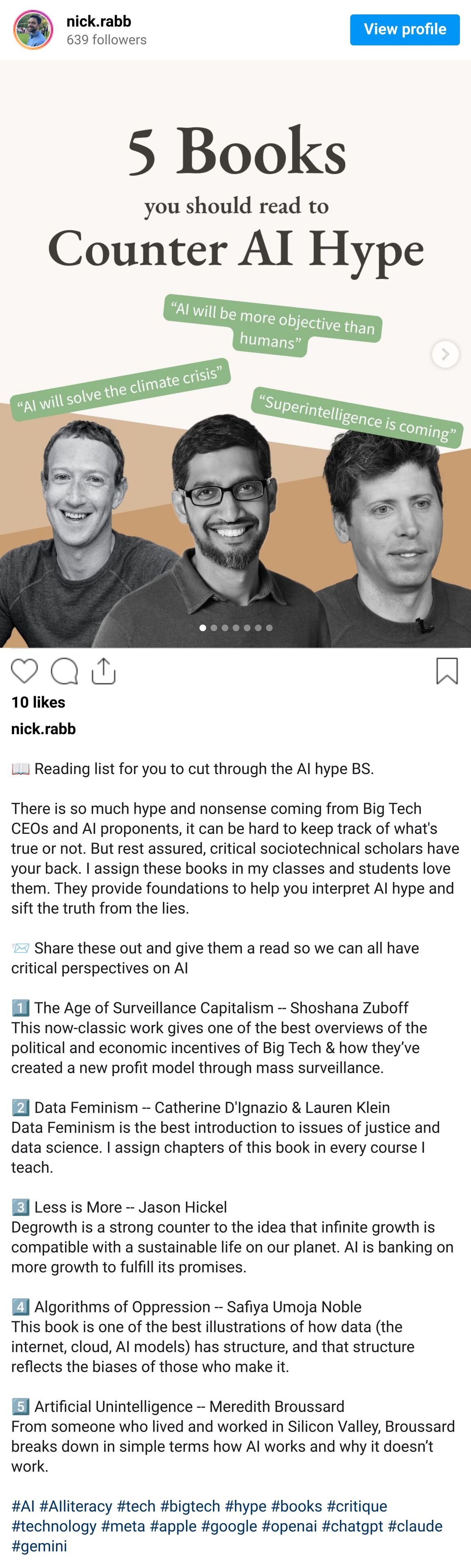
These books are all great introductions to critical data science and AI. The amount of misinformation around AI is tremendous. Most people have no idea how these systems are built, how digital technology architecture shapes information technology, or what the hidden agendas of Big Tech are.
I really recommend you check out these books and others if you want to develop a critical consciousness around AI. In fact, some of the other books folks recommended on social media are:
The AI Con: How to Fight Big Tech’s Hype and Create the Future We Want by Emily Bender & Alex Hanna
AI Snake Oil: What Artificial Intelligence Can Do, What It Can’t, and How to Tell the Difference by Arvind Narayanan & Sayash Kapoor
AI and Critical Thought
I’ve also recently been diving into ways to critically evaluate the effects of AI in education. As I’ve been discussing AI with faculty at Cal State LA, a common theme that I’ve heard from them is that they’re worried that student critical thinking is being eroded by AI. As students are turning in worse work and not seeming to engage with the material, it’s a legitimate worry.
Questions like these have been driving me to work on developing measures that researchers can use to figure out if AI is eroding certain aspects of learning, or not. Critical thinking is the latest of these that I’ve been working on.
I did a bit of literature reviewing and found this book chapter titled “A Model of Critical Thinking in Higher Education,” from the journal Higher Education: Handbook of Theory and Research, published in 2014. This chapter, written by Martin Davies, professor of higher education at University of Melbourne, is an incredible overview and synthesis of decades of research into critical thinking in higher education.
Below is a table that Davies uses to illustrate his model of critical thinking, encompassing several overlapping levels of critical skills that have spanned decades of research.


I found this model incredibly helpful, as when we speak of “critical thinking,” we often have no idea how we would actually describe the skills or attributes under that category. Davies acknowledges this hugely tricky problem early in the paper, and offers these categories as a model. I love this model because it incorporates aspects that I always emphasize with my students: critical thinking encompasses smart analysis skills and also understanding forces shaping society, as well as how to act upon your critical conclusions.
In terms of AI and education, I think this paper has a lot to offer for those hoping to figure out if AI is helping or hindering critical thought. It gives so many examples of skills, attitudes, and predispositions that are involved in being a critical thinker. Being able to lay these out is a step forward for anyone hoping to think critically about AI.
For example, take just the first two groups of critical thinking skills, from Bloom’s taxonomy and the Critical Thinking Movement. They involve things like what Davies calls knowledge (learning definitions), comprehension (learning and being able to produce conceptual explanations), analysis (performing comparison), synthesis (reaching conclusions from analysis), and more. When comparing these to the affordances of, for example, LLMs that students are using for class (e.g., information summarization and synthesis), it’s clear that the AI model, if used by students, does a lot of this work. Would a student habitually using AI for learning atrophy these types of critical thinking skills? It seems likely.
There is much more to investigate by comparing these and other aspects of critical thinking to the affordances and pitfalls of AI models in education. For example, critical pedagogy, interested in having students understand social oppression and how to act to fix it, seems entirely threatened by AI bias and the ability of those controlling models to censor certain topics (which the Trump administration has already declared interest in).
Check out the full paper if you’re interested. If you can’t access it because it’s behind an institutional paywall, reach out to me and I can get you a PDF copy.
A Key Piece of Criticality: Making Change
A final branch of thinking I want to share with you centers around making change given all of the craziness that’s going on. There is much more craziness than just AI and social technology, but I’ll focus down on just that.
I recently posted a Reel describing a broad view of political action, one which is not the typical story we hear when mainstream sources or schools talk about political change.
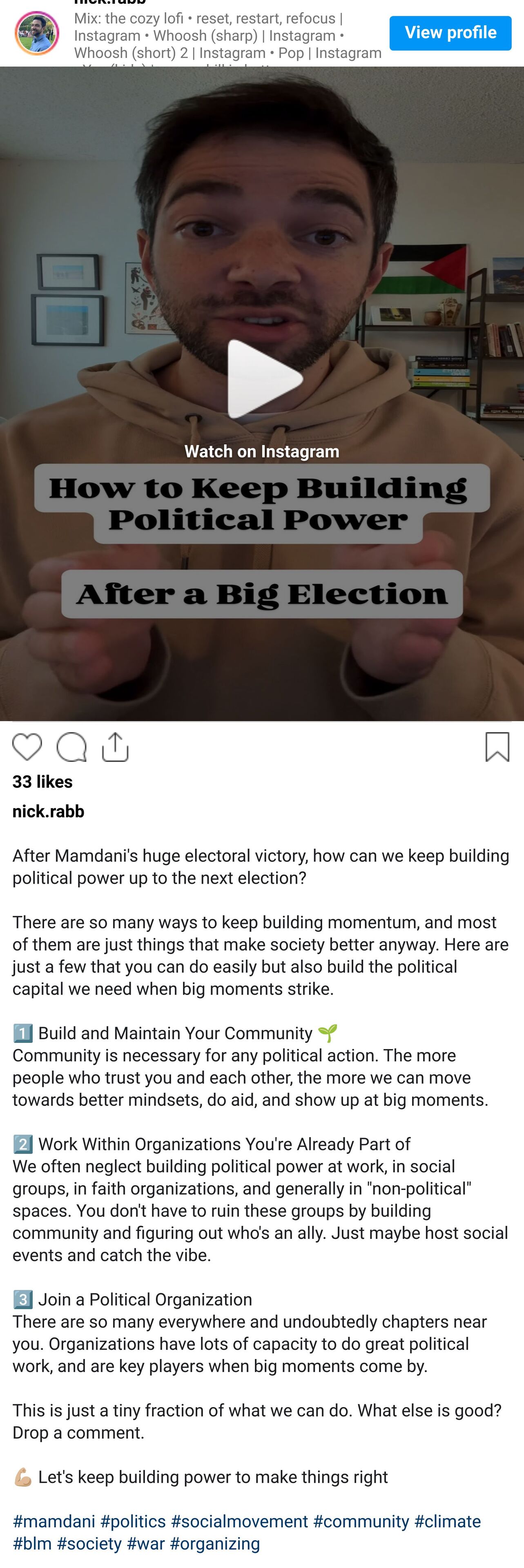
In this Reel, I focus on community-building as a way of building political power between electoral moments. Having strong communities is at the heart of most of social change. Without dense and trusting networks, we are unable to have difficult conversations, be exposed to many views, or take action with large enough groups to make those ruining society quake in their boots.
I wrote about political change in a bit more detail than the Reel covers in a blog post earlier this year. One framework I use in that blog post to discuss ways we can change things is called movement ecology, as conceptualized by Ayni Institute in Boston.

Ayni lays out several ways of making change, including personal transformation, alternatives, and changing dominant institutions. These three strategies are useful in different contexts, for different people at different times, and all work together to make a holistic movement capable of making change. The idea of an ecology is that diverse methods and actors work together, mutualistically, to change the greater environment.
In regards to AI, there is wisdom that we can glean from the ideas of building power through community and making change through any of Ayni’s three categories. We need to be having conversations with each other about the effects of AI — silence and isolation are the best ways that we lose our ability to think and act critically against unjust technologies. For example, in the workplace, we may be given new mandates to use AI, and everyone is upset about it but isolated, not working together, not forming community.
Existing institutions like workplaces and schools are important sites of change to focus on if we have problems with the current proliferation of AI. If universities, colleges, and schools push back against uncritical adoption of AI, it sends signals to the rest of society that the technology should be investigated further. Moreover, challenging AI in educational institutions can also spark wider conversations about EdTech and the privatization of education writ large.
But also, we may be able to all engage in some personal transformation to start pushing back against unjust usages of AI. Reading books like those I linked above are great ways to begin developing a critical consciousness around AI and broader data-driven technologies.
There are many ways to make change. If you read this and think of some others, let me know!
Upcoming Events
💻 Webinar on Tuesday, Nov 18 with the Campaign for Peace, Disarmament and Common Security

I’ll be speaking on a webinar with other young activists and organizers about our perspectives and visions for the future. You can register for the event on Zoom to get the link.
This newsletter provides you with critical information about technology, democracy, militarism, climate and more — vetted by someone who’s been trained both as a scholar and community organizer.
Use this information to contribute to your own building of democracy and fighting against technological domination! And share it with those who would be interested.
Until next time 📣