

Data Center Fights Intensify
Hello and welcome to the latest edition of my newsletter, Poiesis. This newsletter is where I share my research and practice relating to society and technology — AI, misinformation, surveillance, ethics, and more. It’s my way to help you understand and change the rapidly changing world of social technology.
In this edition, I want to share back information I’ve been gathering related to the growing national fight against data centers. In my locality, there have been a few emerging struggles against data centers, notably in Monterey Park. But as I’ve been reading more about the data center fight nationally, I’ve learned some pretty fascinating things about the pro-data center rhetoric, Federal actions clearing the path for construction, and how successful many municipalities have been in stopping construction.
Read on for all of that and more!
Monterey Park’s Fight
In a previous newsletter, I wrote about Monterey Park’s emerging fight against a data center construction project being proposed by a massive Australian investment firm. I shared back last time that tons of residents packed a City Council meeting protesting against the data center. Well, things have only escalated from there.
The main group organizing against the data center, SGV Progressive Action, held a public teach-in about the data center, building on its campaign to push back against construction. To their surprise, and mine, nearly 200 people showed up to this meeting, ready to learn and discuss how to move forward to fight against this project. The energy was pretty incredible.
During the presentation, SGV Progressive Action organizers shared that the data center poses significant environmental and quality of life hazards, as well as threatens to increase financial burdens on residents through increased energy costs. A few facts that I noted down from the presentation are:
The data center would use 2 times the amount of energy as Monterey Park’s existing 20,000 households — a massive amount of power, the equivalent of 40,000 homes.
The facility will use 12 million gallons of water annually, and even though it touts a “water-efficient” design, it still represents a 1% increase in water demand in an already water scarce region; and the developer did not model a drought plan, which is important in Southern California.
Construction of the facility will release a massive amount of Greenhouse Gas (GHG) emissions, and operational emissions from the 24 diesel generators it includes for backup power would be 2.44 tons/year.
This is enough to raise concern. Yet the developer is applying for a truncated environmental review with the City Council, arguing that the impacts are “less than significant” given thresholds for safety under California environmental law. This, SGV Progressive Action argues, is true, yet many of the figures provided by the developer are misleading.
On their website, they provide a detailed critical analysis of the data center’s impacts as compared to the thresholds the developer is aiming at. For example, GHGs emitted during construction do exceed the threshold, but the developer amortizes them over 30 years, arguing that the annual amount is less than significant. Additionally, its diesel generators only come under the emissions threshold if they run solely for their 50-hour testing interval per year — not if they’re used at all during power outages, or sneakily used during normal operations (which the Southern Environment Law Center has documented being the case at xAI’s Boxtown data center, where thermal imaging caught them running 33 generators after claiming to only run 15).
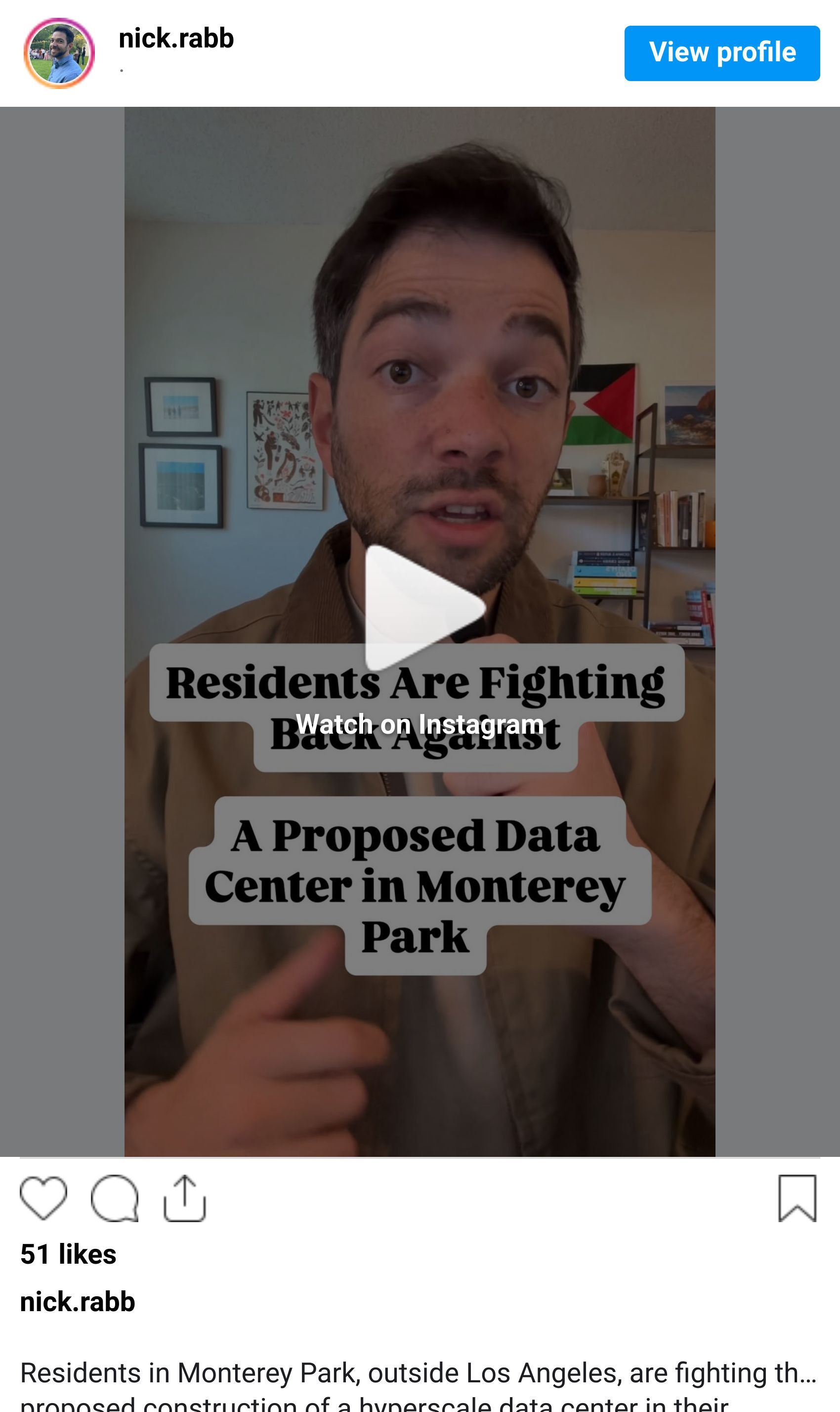
I posted a video about this on IG and TikTok (which had a bit of a viral moment) explaining more of my experience at the teach-in. Residents were eager to pitch in and help, so I’m excited to see how this develops.
There is an upcoming Monterey Park City Council meeting on Wednesday, Jan. 21 at 6:30pm, which I plan on attending. I’ll be sure to share back what happens during that meeting.
Data Center Narrative Wars
While digging into some surface-level research for context on the data center battles across the nation, I found some pretty interesting reporting about Federal government anxieties about the state of the data center push.
Notably, U.S. Energy Secretary Chris Wright seems to be mildly crashing out about the pushback against data centers. In a meeting of the North American Gas Forum, he “warned data center developers that they are losing control of the narrative.” The Washington Post also reported that the executive director of the AI Infrastructure Coalition said that localities are “fueled by misinformation, driven by radical environmental policies, [and] missing out on the jobs, security and opportunities this technology is delivering.”
This anxiety is warranted. Data Center Watch, a nonprofit monitoring data center fights, reported that between May 2024 and May 2025, 6 projects have been completely canceled, and 10 delayed. That equates to $18 billion of investment blocked and $46 billion delayed. Investors are surely very unhappy.
Data Center Watch also finds that backlash is bipartisan. Left-leaning respondents to a survey they distributed were most concerned about environmental impacts, while right-leaning respondents were most concerned about tax abatements given to the developers. Concerns over energy consumption, grid strain, and energy costs were cross-cutting. Somehow, that doesn’t seem like misinformation or radical environmental policies to me.
But the data center lobby is reorienting itself. I found another group called the Data Center Coalition, whose website argues for major benefits from data center construction, including tax revenue, economic productivity, and job creation. They cite a report they commissioned from PwC, which I also saw cited by a pro-data center article from Business Insider.
I read the report to try to understand how they’re arguing the data centers will create jobs. After all, outside of the construction, other articles report that relatively very few people are needed to staff the centers themselves. Here is a table in the PwC report articulating their figures:

Don’t trust these at face value, make sure to look at the methodology in the Appendix
You have to scroll all the way down to their Appendix to see how the come up with these numbers, page 87 of 89. They apparently pull their data from public jobs numbers under NAICS code 518210, which is officially designated as “Data Processing, Hosting, and Related Services.” Of course, I had to look up that NAICS code, and saw on the U.S. Census website that it includes a lot of different jobs, from application hosting, cloud storage, computer time rental, data entry, data processing, to game server hosting, media streaming data storage, platform as a service, crypto mining, and more. On NAICS.com, under this code, one of the top businesses listed is Zynga. You remember, Zynga, right? They created Words With Friends, and are now in the business of game server hosting.
It seems like a pretty huge stretch to argue that these jobs are a direct result of data center construction, especially when the new push for data centers is mostly fueled by the push for AI training and processing, which is decidedly not any of the jobs listed in the above list.
It seems that the major arguments thus far made by developers — jobs, tax income, and “the future” — are falling apart. I would not be surprised if the tactics shift and the Trump administration, Big Tech, and investors turn to new, more classic propaganda arguments to sell the construction of data centers. My prediction is that there will be more of a push for data centers as critical infrastructure or national security infrastructure — the first route having significantly hampered the environmental movement, as fighting critical infrastructure can have you slapped with felonies; and the second having continued to manufacture consent for the extremely wasteful and toxic military-industrial complex.
Or maybe I’m giving too much credit to the data center developer industry and the current administration. After all, Energy Secretary Wright is formerly famous for being the fracking CEO that drank fracking fluid on camera as a way to try to argue that fracking is not dangerous. In his own admission, it contained bleach, soap, and plastic.
Machine New Deal
The more I read about how hard the administration is pushing AI and data centers, the more I can’t help but compare to the work I did in 2019 to push for the Green New Deal. Similarly, the GND was a plan pushing for a social and economic revolution, using Federal mandates to direct and incentivize construction of renewable energy infrastructure across the country, modernize energy grids, restore biodiversity and ecosystems, and create millions of unionized jobs in the process. The AI push is like that, but the version where you reverse all the colors and it looks cursed.
Instead of pushing for nationwide infrastructure and jobs as a way to drastically curb the worsening climate crisis, enacting social and ecological justice, the AI push promises infrastructure and jobs for what — AI sexual assaults, misinformation, slop, air pollution, water scarcity. Somehow we’ve fallen into this dystopia where these are markers of progress to some people, whereas when we argued for restoring health and life to the society, we were met with calls of “too expensive” or “unrealistic.”
This upside-down world we’re living in is perhaps best exemplified by the recent update to the official EPA website, which rolled out a page full of resources for data center developers to use to skirt around the Clean Air Act. It claims:
“Cutting overly burdensome red tape will help power AI Infrastructure development nationally. Additionally, by streamlining reviews under the Clean Air Act (CAA), innovators and infrastructure developers can move more confidently and quickly.”
This falls under EPA Administrator Lee Zeldin’s “Powering the Great American Comeback” initiative.
In fact, one of the key enemies of the Green New Deal, and its later, weaker incarnation as the Build Back Better Act, former Democratic (laughably) Senator Kirsten Synema, recently made headlines by lobbying for a data center construction project in Arizona. The community didn’t want the project, but Synema, on behalf of her new consulting role for Hogan Lovells, a global law firm, attempted to sway the city council by arguing if they don’t build it, Trump will build it anyway. She claimed to be working “hand in glove with the Trump administration” on AI.
Well the city council of Chandler, AZ rejected that data center unanimously, dealing a decisive blow to Synema and her new best friend, Trump.
It’s clear that this AI push is simply riddled with power-plays orchestrated by the most unscrupulous, sycophantic, opportunistic power-brokers in the nation. In contrast to the Green New Deal, a principled, justice-oriented movement to revolutionize society, it reveals itself as a jumble of lies and intimidations.
This newsletter provides you with critical information about technology, democracy, militarism, climate and more — vetted by someone who’s been trained both as a scholar and community organizer.
Use this information to contribute to your own building of democracy and fighting against technological domination! And share it with those who would be interested.
Until next time 📣